What to Expect When You Contact Us?

Restoring Human Dignity
Order for Restoring Peace on Earth (O.R.P.E.)
-
USCIS Policy Manual, Chapter 2 – Definition of Child for Citizenship and Naturalization
-
USCIS Policy Manual, Chapter 3 – United States Citizens at Birth (INA 301 and 309)
-
USCIS Policy Manual, Chapter 4 – Automatic Acquisition of Citizenship after Birth (INA 320)
-
USCIS Policy Manual, Chapter 5 – Child Residing Outside of the United States (INA 322)
-
USCIS Policy Manual, Chapter 2 – Definition of Child for Citizenship and Naturalization
-
USCIS Policy Manual, Chapter 3 – United States Citizens at Birth (INA 301 and 309)
-
USCIS Policy Manual, Chapter 4 – Automatic Acquisition of Citizenship after Birth (INA 320)
-
USCIS Policy Manual, Chapter 5 – Child Residing Outside of the United States (INA 322)

RESTORING DIGNITY. REBUILDING LIVES. TRANSFORMING COMMUNITIES
Restoring Dignity Through Life-Saving Relief, Community Recovery, and Sustainable Self-Sufficiency
Across crisis-affected communities, millions of vulnerable individuals and families face the devastating consequences of poverty, displacement, illness, injustice, unemployment, social exclusion, and institutional neglect. These conditions undermine human dignity, limit opportunity, and weaken community resilience. The ORPE Human Rights Advocates (ORPE-HRA) Restoring Human Dignity Fund was established to provide an integrated, sustainable, and human-centered response to these challenges. The Fund serves as a strategic financing mechanism that enables vulnerable populations to access life-saving services while creating pathways toward long-term self-reliance, economic empowerment, justice, and social inclusion. Through a coordinated network of healthcare professionals, social workers, legal advocates, community development specialists, educators, and humanitarian responders, ORPE delivers comprehensive interventions designed to restore hope, protect rights, and strengthen communities. Why Your Support Matters For many vulnerable families, a single crisis can trigger a cycle of poverty, homelessness, illness, exploitation, and social exclusion. Traditional interventions often address only one problem at a time. ORPE's model recognizes that human dignity can only be restored when health, protection, justice, education, livelihoods, and community support systems work together.

Restore Human Dignity Through a Coordinated Human and Social Services Wraparound System
Every Family Deserves a Complete Pathway to Hope, Healing, and Stability

Our Model for Driving Systemic Change
ORPE Human Rights Advocates drives systemic change through an integrated, five-pillar operational model that moves communities from crisis to long-term resilience. We begin with rapid humanitarian response to stabilize vulnerable populations, then advance justice and rule of law to address root causes of abuse and inequality. By cultivating ethical, truth-driven leadership and strengthening institutional capacity, we reinforce the systems that uphold accountability and service delivery. Finally, we empower communities to lead their own sustainable development. This coordinated approach ensures that change is not temporary, but structural, scalable, and enduring transforming not only conditions on the ground, but the systems that shape them.


Pillar 01
Humanitarian Action
Restoring Human Dignity Through Integrated Humanitarian Response and Community Resilience.
Pillar 02
Advancing Justice & Rule of Law
Advancing Justice and the Rule of Law Through Professional Development in Adversarial Legal Systems and Modern Litigation Techniques.
Pillar 03
Truth-Driven Leadership for Justice & Transformational Leaders
Advancing Justice, Democratic Governance, and Sustainable Peace Through Transformational Leadership Development.
Pillar 04
Strengthening Institutions Through Capacity Building
Strengthening Institutional Capacity for Justice, Good Governance, and Sustainable Development.
Pillar 05
Empowering Communities for Sustainable Development
Investing in Communities That Build Their Own Future: From Immediate Opportunity to Sustainable Prosperity
Delivering Life-Saving Assistance Where It Is Needed Most.
When communities are struck by conflict, disaster, or systemic neglect, ORPE deploys rapid, principled humanitarian assistance: Emergency food, shelter, and medical support; Protection of vulnerable populations (women, children, displaced persons); Restoration of immediate human dignity in life-threatening conditions.
I. PROGRAM OBJECTIVE To deliver coordinated, timely, and rights-based crisis response by integrating humanitarian assistance, social services, justice systems, and community structures into a unified operational ecosystem. II. SYSTEM ARCHITECTURE 1. Core System Layers A. Crisis-Affected Population (Center of the System) * Vulnerable individuals (women, children, displaced persons, survivors of violence) * Households and communities * At-risk groups (youth, elderly, disabled) B. Integrated Service Delivery System (Primary Layer) 1. Emergency Humanitarian Support * Food, shelter, water, sanitation (WASH) * Emergency health services * Protection services (GBV, child protection) 2. Social Support Services * Psychosocial support (PSS) * Social protection (cash transfers, safety nets) * Family reunification and community reintegration 3. Justice & Protection Services * Legal aid and rights protection * Documentation and civil registration * Protection monitoring and case management 4. Livelihood Recovery System * Emergency livelihoods * Skills training and income generation * Economic reintegration programs C. Institutional & Coordination Layer * Government ministries (health, justice, social affairs) * Local authorities * NGOs/CSOs * International agencies * Community-based organizations (CBOs) D. Enabling Systems Layer * Data & information systems * Financing systems * Policy and legal frameworks * Logistics and supply chains III. SYSTEM DYNAMICS 1. Integrated Service Flow Identification → Referral → Service Delivery → Follow-up → Reintegration * Rapid identification of vulnerable individuals * Multi-sector referral pathways * Coordinated service delivery * Continuous case tracking * Long-term recovery support 2. Feedback Loops Reinforcing Loop Access to services → improved well-being → increased trust → higher service uptake → stronger system performance Corrective Loop Monitoring → gap identification → system adjustment → improved response quality 3. Interoperability Principle All subsystems operate through: * Shared data platforms * Standardized protocols * Coordinated response frameworks IV. METHODS (IMPLEMENTATION APPROACHES) 1. Integrated Case Management Approach * Assign case workers per household/individual * Develop individualized response plans * Track services across sectors 2. One-Stop Service Delivery Model Establish Integrated Crisis Response Centers Co-locate: * Health services Legal aid * Psychosocial support * Social protection 3. Community-Based Response Model * Train community focal points * Deploy outreach teams * Use local networks for identification and monitoring 4. Rapid Response & Surge Capacity Model * Pre-position emergency teams and resources * Activate response within 24–72 hours * Use mobile service delivery units 5. Continuum of Care Approach * Link emergency → recovery → development * Prevent relapse into crisis * Ensure long-term resilience V. MECHANISMS (OPERATIONAL TOOLS) 1. Coordination Mechanisms * Emergency Operations Centers (EOCs) * Inter-agency coordination platforms * Cluster or sector coordination systems 2. Service Delivery Mechanisms * Mobile clinics and outreach teams * Safe spaces for vulnerable populations * Digital service access platforms 3. Referral Mechanisms * Standardized referral pathways * Interoperable service directories * Case escalation protocols 4. Data & Information Mechanisms * Integrated Case Management Systems (ICMS) * Beneficiary registries * Real-time dashboards 5. Accountability Mechanisms * Complaint & feedback systems * Community monitoring committees * Third-party evaluations 6. Financing Mechanisms * Emergency pooled funds * Cash transfer systems * Results-based financing 7. Protection Mechanisms * Safeguarding policies * Confidential data systems * Survivor-centered response protocols VI. IMPLEMENTATION PHASES Phase 1: Preparedness * Risk mapping and vulnerability assessments * Pre-position resources and partnerships * Develop contingency plans Phase 2: Rapid Response * Activate emergency systems * Deploy mobile teams * Deliver life-saving assistance Phase 3: Stabilization * Expand integrated services * Strengthen coordination * Initiate case management Phase 4: Recovery * Restore livelihoods * Reinforce institutions * Transition to development programs Phase 5: Resilience Building * Strengthen community systems * Institutionalize response mechanisms * Reduce future vulnerability VII. KEY PERFORMANCE INDICATORS (KPIs) Access & Coverage * % of affected population reached * Time to service delivery Protection * Number of protection cases resolved * Reduction in violence/exploitation * Service Integration * % of cases receiving multi-sector support * Referral completion rate Recovery * % of beneficiaries achieving economic stability * Reintegration success rates VIII. EXPECTED OUTCOMES Short-Term * Immediate life-saving support delivered * Rapid stabilization of affected populations Medium-Term * Improved well-being and protection * Functional service delivery systems Long-Term * Resilient communities * Institutionalized crisis response systems * Sustainable human development outcomes IX. THEORY OF CHANGE (DONOR-ALIGNED) Inputs → Activities → Outputs → Outcomes → Impact * Inputs: Resources, systems, partnerships * Activities: Integrated service delivery, coordination * Outputs: Services delivered, cases managed * Outcomes: Improved protection, recovery, and access * Impact: Resilient, protected, and self-sustaining communities X. CRITICAL SUCCESS FACTORS * Strong inter-agency coordination * Community trust and participation * Data-driven decision-making * Flexible and sustainable financing * Institutional ownership
Restoring Dignity Through Justice Systems That Protect the Vulnerable and Hold Wrongdoers Accountable
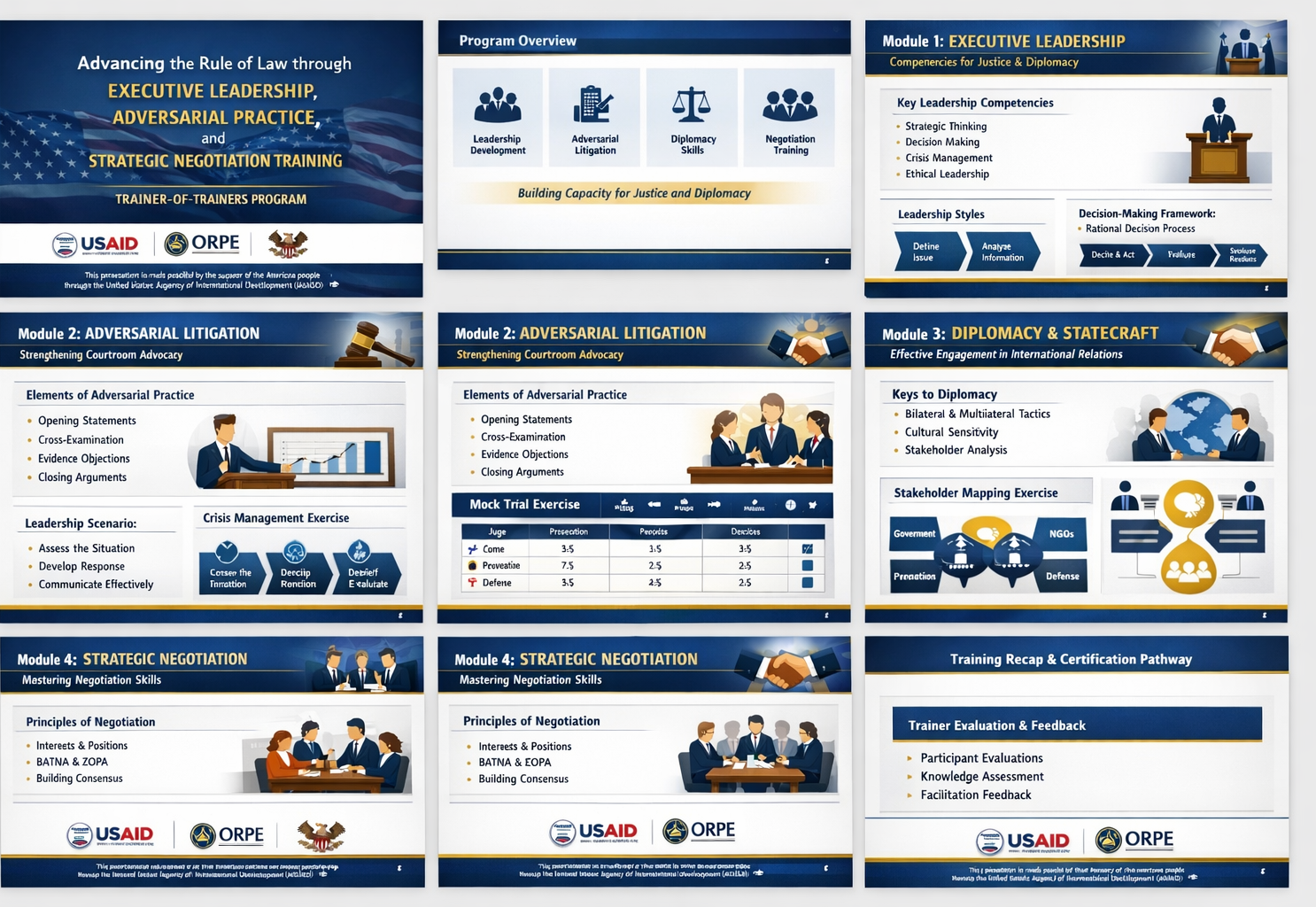
To strengthen adversarial judicial practice across courts and legal institutions, ensuring fair trials, institutional accountability, and sustainable peace grounded in the rule of law. This includes a structured transition from inquisitorial traditions to rights-based adversarial models.
I. SYSTEM COMPONENTS 1. Inputs (System Enablers) * Judicial trainers, legal experts, and human rights advisors * Standardized curricula on adversarial trial procedures, evidence law, and judicial ethics * Strategic partnerships with courts, bar associations, and civil society organizations * Digital case management, data collection, and monitoring platforms * Adequate funding, infrastructure, and access to legal reference materials 2. Core Subsystems A. Judicial Capacity Development * Deliver targeted training for judges, prosecutors, defense counsel, and court personnel in adversarial procedures * Conduct practical workshops on evidence handling, witness examination, and trial advocacy * Promote ethical integrity and impartial decision-making in judicial proceedings B. Institutional Reform * Align procedural rules and case management systems with adversarial standards * Strengthen court administration to ensure public hearings and due process protections * Establish or reinforce independent oversight bodies for judicial conduct C. Legal Aid and Public Access * Expand access to qualified and independent defense counsel * Provide legal assistance and rights awareness programs for litigants * Enhance transparency and encourage public participation in judicial processes D. Monitoring and Accountability * Track judicial adherence to adversarial standards and due process requirements * Monitor compliance with human rights obligations and procedural fairness * Document violations and issue evidence-based recommendations for reform 3. Outputs * Legal professionals trained and proficient in adversarial practice * Reformed court procedures and modernized case management systems * Expanded and accessible legal aid services * Publicly available monitoring and performance reports on judicial institutions 4. Outcomes * Increased fairness, transparency, and consistency in trials * Reduction in bias, corruption, and arbitrary decision-making * Strengthened public trust in judicial institutions * Enhanced accountability of judges, prosecutors, and court personnel 5. Impact * Institutionalization of adversarial legal practice * Strengthened rule of law and protection of fundamental human rights * Durable peace and social cohesion grounded in justice * Sustainable and accountable democratic governance II. SYSTEM DYNAMICS Feedback Loops * Reinforcing Loop: Fair trials → increased public confidence → higher legal compliance → stronger institutional legitimacy → broader adoption of adversarial norms * Corrective Loop: Monitoring → identification of systemic gaps → targeted training and procedural reform → continuous system improvement Interdependencies * Judicial training drives effective institutional reform * Legal aid enables meaningful public participation and equality before the law * Oversight and monitoring mechanisms reinforce transparency and accountability III. METHODS (Implementation Approaches) Capacity Building * Develop modular training programs for judicial actors and court personnel * Establish continuous professional development in trial advocacy * Facilitate peer exchange programs with jurisdictions practicing adversarial systems Legal System Transformation * Conduct audits and redesign procedural frameworks to support adversarial trials * Reform caseflow management to ensure timely and efficient hearings * Institutionalize the right to defense counsel in all applicable proceedings Public Engagement and Rights Awareness * Implement community outreach initiatives on fair trial rights and procedures * Promote public monitoring and reporting of court proceedings * Expand legal aid clinics and pro bono legal services Monitoring and Evaluation * Establish standardized judicial performance indicators * Conduct periodic audits and independent trial observation missions * Create feedback mechanisms for litigants, civil society, and legal practitioners IV. MECHANISMS (Optional Tools) Coordination Mechanisms * Judicial reform task forces * Inter-institutional coordination committees (courts, bar associations, civil society) Training Mechanisms * E-learning platforms for continuous legal education * Simulation courts and mock trial exercises * Mentorship programs led by experienced adversarial practitioners Case Management Mechanisms * Digital case tracking and analytics systems * Standard operating procedures (SOPs) for hearings, evidence management, and appeals Accountability Mechanisms * Independent judicial oversight bodies * Accessible complaint and redress systems for litigants * Public transparency portals with case and performance data Legal Aid Mechanisms * Public defender networks * Community-based paralegal programs * Mobile legal aid delivery units Advocacy and Policy Mechanisms * Strategic litigation to establish and reinforce adversarial jurisprudence * Legislative reform proposals aligned with fair trial standards * Civil society advocacy campaigns promoting judicial accountability V. IMPLEMENTATION PHASES 1. Assessment and Mapping * Evaluate judicial capacity, procedural gaps, and institutional constraints * Identify key stakeholders and reform champions * Training and Pilot Programs 2. Launch pilot adversarial courts in selected jurisdictions Deliver intensive training for judicial and legal actors 3. System Integration * Implement case management reforms and procedural updates * Institutionalize monitoring and accountability frameworks 4. Scaling and Institutionalization * Expand adversarial practices across jurisdictions * Integrate reforms into national legal and judicial standards 5. Evaluation and Feedback * Measure performance, public trust, and fair trial outcomes * Refine strategies based on data and lessons learned VI. KEY PERFORMANCE INDICATORS (KPIs) * Percentage of judicial actors trained in adversarial procedures * Number and proportion of cases conducted under adversarial standards * Reduction in case backlog and trial duration * Levels of litigant satisfaction and public trust * Number of judicial misconduct cases addressed * Adoption rate of procedural reforms at the national level VII. SYSTEM OUTCOME MAP Inputs → Capacity Building & Legal Reform → Reformed Court Procedures & Legal Aid Access → Monitored and Transparent Trials → Fair Trial Outcomes → Institutionalized Adversarial Practice → Strengthened Rule of Law and Durable Peace * Continuous feedback through monitoring, evaluation, and mentorship * Integrated coordination across courts, legal professionals, civil society, and public institutions VIII. CRITICAL SUCCESS FACTORS * Sustained political and institutional commitment to judicial reform * Active engagement of trained practitioners as mentors and reform leaders * Effective and independent monitoring and accountability systems * Public awareness and participation in judicial processes * Reliable funding and infrastructure support
Cultivating Truth-Driven Transformational Leaders to Advance Human Dignity, Justice, and Lasting Peace Across Communities and Nations
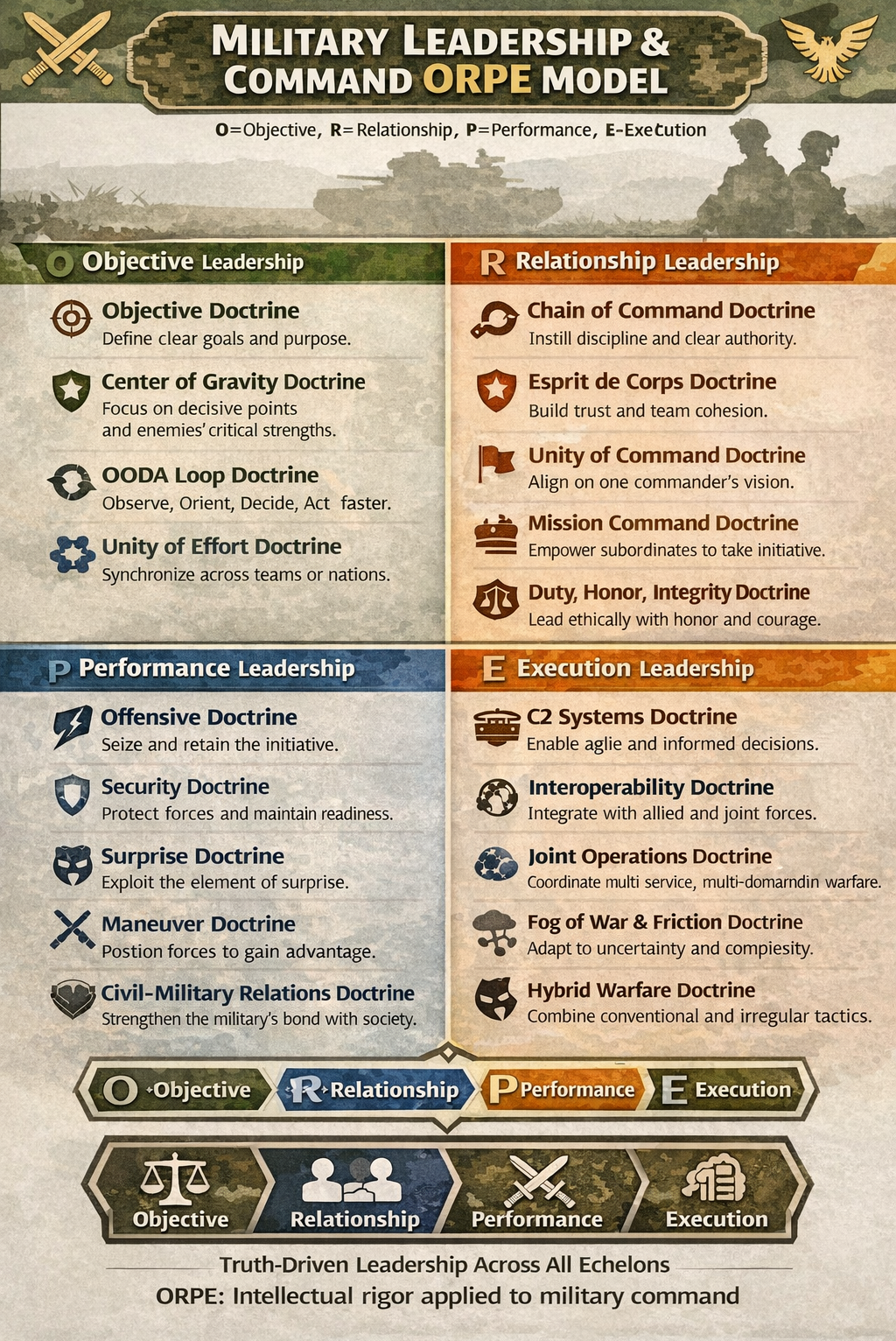
Operationalizing the Doctrine of Truth-Driven Decision-Making in Leadership.
To institutionalize a leadership system grounded in truth, moral integrity, and human dignity, empowering leaders to transform organizations, communities, nations, and global systems toward equity, justice, peace, and the restoration of humanity’s relationship with the Divine.
I. CORE PRINCIPLE TRUTH AS THE SUPREME DECISION-MAKING STANDARD All leadership decisions within ORPE-HRA shall be guided by objective truth, ethical responsibility, and respect for inherent human dignity, transcending personal, political, or institutional bias. II. SYSTEM ARCHITECTURE 1. INPUTS (Foundational Drivers) * Ethical and moral frameworks rooted in human dignity and universal justice * Verified facts, evidence, and lived realities of affected populations * Human rights law, constitutional principles, and international norms * Spiritual and moral reflection aligned with higher ethical order * Stakeholder perspectives, especially vulnerable and marginalized groups 2. CORE SUBSYSTEMS A. Truth Identification System * Evidence-based fact-finding and verification processes * Multi-source validation (legal, social, empirical, testimonial) * Distinction between truth, perception, bias, and misinformation B. Ethical Discernment System * Alignment of facts with moral principles and human dignity * Evaluation of consequences on vulnerable populations * Integration of justice, equity, and peace considerations C. Decision Integrity System * Structured decision protocols anchored in truth and ethics * Elimination of conflicts of interest and undue influence * Documentation and justification of decisions for transparency D. Transformational Leadership System * Development of leaders capable of acting on truth despite resistance * Courage-based leadership training and moral accountability * Capacity to influence institutional and societal transformation E. Accountability and Reflection System * Continuous monitoring of decisions and their outcomes * Feedback loops from communities and stakeholders * Mechanisms for correction, repentance (where applicable), and improvement 3. OUTPUTS * Decisions grounded in verified truth and ethical reasoning * Transparent and documented leadership actions * Empowered leaders capable of principled transformation * Increased trust and legitimacy in leadership structures 4. OUTCOMES * Reduction of injustice, bias, and corruption in decision-making * Strengthened institutional credibility and moral authority * Enhanced protection of vulnerable populations * Increased alignment between leadership actions and ethical truth 5. IMPACT * Restoration of human dignity as a governing principle * Sustainable systems of justice, equity, and peace * Transformation of leadership culture across sectors * Reconciliation between humanity, truth, and the Divine moral order III. DECISION-MAKING FLOW MODEL TRUTH-DRIVEN LEADERSHIP CYCLE 1. Truth Discovery: Gather and verify all relevant facts and realities 2. Truth Validation: Cross-check evidence through independent and credible sources 3. Ethical Alignment: Assess consistency with human dignity, justice, and moral principles 4. Impact Assessment: Evaluate consequences on individuals, especially the vulnerable 5. Decision Formulation: Select the course of action aligned with truth and justice 6: Transparent Implementation: Execute decisions with openness and accountability 7. Monitoring and Feedback: Track outcomes and gather stakeholder input 8: Correction and Growth: Adjust decisions and systems where truth reveals gaps IV. SYSTEM DYNAMICS Feedback Loops * Reinforcing Loop: Truth-based decisions → trust → legitimacy → broader influence → stronger truth adherence * Corrective Loop: Feedback → identification of deviation from truth → corrective action → system improvement Interdependencies * Truth requires both evidence and ethical interpretation * Leadership effectiveness depends on accountability mechanisms * Community trust reinforces system sustainability V. OPERATIONAL METHODS 1. Capacity Development * Training in critical thinking, ethics, and evidence-based analysis * Leadership formation programs focused on integrity and courage * Spiritual and moral reflection practices integrated into leadership 2. Institutional Integration * Embedding truth-driven protocols into governance structures * Establishing independent review and ethics committees * Aligning policies with truth-based decision standards 3. Community Engagement * Inclusion of affected populations in decision processes * Public forums for truth-sharing and dialogue * Protection of whistleblowers and truth-tellers 4. Monitoring and Evaluation * Truth-alignment indicators for decisions and policies * Periodic ethical audits and leadership assessments * Public reporting on decision integrity VI. MECHANISMS (TOOLS AND STRUCTURES) Decision Protocol Mechanisms * Standardized Truth- Assessment Framework (TAF) * Ethical Impact Assessment tools * Decision documentation templates Accountability Mechanisms * Independent ethics and oversight bodies * Transparent reporting systems * Complaint and redress channels Leadership Mechanisms * Mentorship programs for emerging leaders * Peer accountability circles * Leadership evaluation based on truth adherence Knowledge Mechanisms * Centralized repository of verified data and case studies * Research units for evidence-based advocacy * Continuous learning platforms VII. IMPLEMENTATION PHASES 1. Foundation Building: Define doctrine, principles, and operational standards 2. Capacity Formation: Train leaders and institutions in truth-driven methodologies 3. Pilot Application: Implement in selected programs or jurisdictions 4. System Integration: Embed into organizational governance and decision-making 5. Scaling and Replication: Expand across sectors and geographic regions 6. Continuous Evaluation: Refine through feedback, monitoring, and learning
Invest in Resilient Institutions That Restore Dignity Through Justice, Good Governance, and Sustainable Service Delivery
ORPE builds resilient institutions that can sustain justice and service delivery long-term.
-
Training public institutions and civil society organizations
-
Strengthening governance systems and operational frameworks
-
Enhancing service delivery infrastructure
I. Core Methodology (Systems Approach) 1. Systems Mapping and Diagnostics Objective: Identify structural weaknesses, fragmentation, and leverage points. Methods: * Institutional capacity assessments (legal, operational, financial). * Stakeholder ecosystem mapping (state, civil society, justice actors). * Service delivery chain analysis (access → adjudication → enforcement) * Political economy and risk analysis Output: System map + institutional gap analysis + reform priorities 2. Integrated Institutional Strengthening Model Objective: Address capacity holistically (not in silos). Pillars of Capacity: * Legal and Policy Frameworks (alignment with human rights standards). * Organizational Capacity (structures, mandates, workflows) * Human Capital (skills, ethics, leadership) * Operational Systems (case management, data systems) * Financial Sustainability Output: Institutional strengthening roadmap (multi-year) 3. Service Integration Architecture Objective: Break fragmentation across justice and human rights services. Methods: * One-stop service delivery models (legal aid + psychosocial + mediation) * Inter-agency coordination protocols. * Referral and case-tracking systems * Digital platforms for integrated service access Output: Integrated service delivery framework 4. Adaptive Governance and Continuous Learning Objective: Ensure resilience and long-term effectiveness. Methods: * Feedback loops (citizen reporting, grievance mechanisms) * Real-time monitoring dashboards * Iterative policy adjustments (“learning by doing”) * Institutional performance reviews Output: Adaptive governance model II. Key Mechanisms for Implementation 1. Legal and Regulatory Mechanisms * Law reform aligned with international human rights standards * Strengthening judicial independence and oversight bodies * Codification of inter-agency coordination mandates 2. Institutional Coordination Mechanisms * National coordination platforms (justice, police, social services) * Inter-ministerial task forces * Memoranda of Understanding (MOUs) between institutions * Decentralized coordination units at local levels 3. Capacity Development Mechanisms * Continuous professional training (judges, prosecutors, law enforcement) * Leadership and ethics development programs * Institutional mentoring and peer-learning networks * Technical assistance and embedded advisors 4. Service Delivery Mechanisms * Integrated legal aid and human rights centers * Mobile justice clinics for underserved communities * Digital access platforms (case filing, tracking, legal information) * Community-based dispute resolution systems 5. Accountability and Oversight Mechanisms * Independent oversight institutions (ombudsman, human rights commissions) * Community monitoring and social accountability tools * Transparency portals (budgets, case outcomes) * Anti-corruption safeguards 6. Data, Technology, and Knowledge Systems * Integrated case management systems * Data-sharing protocols across institutions * Evidence-based policymaking tools * Periodic impact evaluations and public reporting 7. Community Engagement Mechanisms * Civic education on rights and legal processes * Community dialogue and reconciliation platforms * Partnerships with civil society organizations * Inclusion of vulnerable and marginalized groups 8. Financial and Sustainability Mechanisms * Medium-term institutional budgeting frameworks * Donor coordination platforms * Results-based financing models * Public-private partnerships where appropriate III. Implementation Phases (Operational Roadmap) Phase 1: Diagnostic & Design * System mapping * Capacity assessment * Stakeholder alignment Phase 2: Institutional Strengthening * Legal reforms * Capacity building * Systems development Phase 3: Service Integration * Rollout of integrated service models * Digital and coordination systems Phase 4: Scaling & Sustainability * Institutionalization of reforms * Long-term financing * Continuous evaluation IV. Expected Outcomes * Improved access to justice (especially for vulnerable populations) * Reduced institutional fragmentation * Stronger rule of law and accountability systems * Enhanced public trust in institutions * Sustainable, rights-based service delivery systems V. Strategic Positioning for ORPE This framework enables ORPE Human Rights Advocates to function as: * A systems integrator (bridging institutions and services) * A capacity builder (strengthening leadership and institutions) * A policy influencer (driving legal and governance reforms) * A service innovator (developing integrated justice models)
Restoring Human Dignity by Empowering Self-Sustaining Communities to Lead Inclusive Development and Lasting Change
ORPE empowers communities through an integrated systems approach that combines economic opportunity, digital connectivity, local leadership, institutional capacity, and rule-of-law outcomes. Our I.S.M. Framework delivers income within 30 days while building the long-term resilience and market power communities need to thrive independently.
I. ENHANCED OPERATIONAL MODEL “INCOME NOW → DIGITAL ACCESS → SYSTEM BUILD → MARKET POWER (I.D.S.M. Framework)” Key Shift: Digital infrastructure is treated as economic infrastructure, equivalent to roads, storage, or irrigation. Strategic Functions of the Digital Layer: * Unlock market access (pricing, buyers, platforms) * Enable financial inclusion (mobile money, digital credit) * Drive efficiency (logistics, aggregation, forecasting) * Strengthen accountability (real-time data and transparency) II. PHASED OPERATIONAL PROCESS (WITH DIGITAL INTEGRATION) Phase 1: Immediate Economic Activation + Digital Access (0–90 Days) Objective: Deliver income and connectivity simultaneously. Core Methods: 1. Rapid Livelihood Deployment Units (RLDUs) + Digital Mapping * Integrate digital asset mapping tools (mobile-based surveys) * Register all beneficiaries in a digital registry (baseline data and ID) Outcome: → Immediate inclusion in both economic and digital ecosystems 2. Community Connectivity Hubs (“Digital Access Points”) Solar-powered hubs providing: * Internet connectivity (satellite or mobile broadband) * Shared devices (tablets, laptops) * Charging stations Deployment Model: * One hub per 2–3 communities * Managed by trained local “Digital Facilitators” Outcome (within 30 days): → First-time internet access for underserved populations 3. Mobile Money and Digital Payments Activation * Register beneficiaries on mobile wallets and digital payment systems Cases: * Cash-for-work payments * Market transactions * Savings contributions Outcome: → Immediate financial inclusion and reduced cash leakage 4. Digital Market Access (“e-Market Days”) Complement physical markets with: * ORPE's social media platform * WhatsApp-based trading groups * SMS price alerts * Digital buyer–seller matching Outcome: → Expanded market reach beyond local geography 5. Digital Starter Training (Ultra-Short Format) Delivered within the first 2–3 weeks: * Using mobile phones for business * Mobile money transactions * Basic online selling Outcome: → Immediate practical usability (not theoretical training) Immediate Outputs (0–90 Days): * % of beneficiaries digitally registered * % using mobile money * % of transactions conducted digitally * % accessing connectivity hubs * Income generated through digital channels III. PHASE 2: SYSTEMS STRENGTHENING + DIGITAL ECONOMY INTEGRATION (3–18 Months) Core Methods (Enhanced): 1. Digital Value Chain Systems * Digital aggregation platforms * Inventory tracking tools * Price intelligence dashboards Example: Farmers check real-time prices before selling 3. Community Enterprise Clusters (CECs) + Digital Platforms * Group messaging platforms * Shared digital bookkeeping * Order coordination tools 3. Financial Inclusion → Digital Finance Ecosystem * Digital credit scoring (based on transaction history) * Mobile-based microloans * Digitized savings systems 4. Structured IT Capacity *Building (Training of Trainers Model) Training Tracks: * Basic digital literacy (device use, internet navigation) * Business technology use (payments, marketing, recordkeeping) * Advanced (youth-focused): e-commerce, digital services, data entry 5. Digital Procurement and Market Linkages * Connect cooperatives to online procurement systems * Link to institutional buyers via digital platforms Intermediate Outcomes: * % of enterprises using digital tools * Increased price transparency * Reduced transaction costs * Expanded access to digital finance IV. PHASE 3: DIGITAL MARKET POWER AND SUSTAINABILITY (18–48 Months) Core Methods: 1. Community-Owned Digital Platforms * Cooperative-managed market platforms, pricing systems, and buyer networks 2 . Rural E-Commerce Enablement * Direct-to-consumer sales * Regional and export market access 3. Digital Service Economy Creation New local jobs: * Digital agents * Platform managers * IT support providers 4. Data-Driven Economic Governance * Data used for pricing decisions, policy advocacy, and resource allocation 5. Full Digital Ownership Transition * Community control of connectivity hubs, platforms, and data systems Long-Term Outcomes: * Digitally connected rural economies * Increased incomes through expanded markets * Reduced exploitation by intermediaries * Sustainable, tech-enabled economic ecosystems V. CORE DELIVERY ENGINE (DIGITAL-ENABLED) 1. “Income + Connectivity” Dual Mandate Every beneficiary must: * Earn income and * Gain digital access within 30 days 2. Digital-First Market Access * Price discovery, buyer identification, and transactions increasingly digital 2. Hybrid Model (Online + Offline) * Physical markets remain * Digital systems expand reach and efficiency 4. Data as an Asset * Communities own and leverage economic data for negotiation and scaling 5. Local Digital Capacity * No long-term external dependency * Local trainers sustain knowledge systems VI. MEASUREMENT FRAMEWORK (DIGITAL KPIs) Immediate (0–6 Months): * % of beneficiaries with mobile money accounts * % accessing internet hubs * Number of digital transactions per user * Income generated via digital channels Intermediate (6–18 Months): * % of businesses using digital tools * % with access to digital finance * % reduction in transaction costs Long-Term (18–48 Months): * % of trade conducted digitally * Digital income share of household income * Local digital ecosystem sustainability index VII. IMPLEMENTATION STRUCTURE (WITH DIGITAL ROLES) Community Level: * Economic Action Groups (EAGs) * Digital Facilitator (new role) * Local trainers District Level: * Value Chain Specialist * Financial Inclusion Officer * ICT and Systems Officer (new) * Market Linkage Coordinator National Level: * Program Director * Digital Infrastructure Lead (new) * Data and MEL Director VIII. DIGITAL COST ADD-ON (BUDGET INTEGRATION) Additional Cost per Beneficiary: * Connectivity infrastructure (shared): $40 * Devices (shared access model): $30 * Training (digital literacy and IT): $25 * Platform and data systems: $15 Total Digital Add-On: ≈ $110 per beneficiary Updated Total Cost per Beneficiary: $527 → approximately $637 IX. DIGITAL ROI IMPACT Income multiplier improves: 5.1x → approximately 6.5x ROI Key Drivers: * Improved pricing access * Expanded markets * Reduced inefficiencies * Increased access to finance X. 90-DAY GUARANTEED RESULTS (DIGITAL-INCLUSIVE) Each community must achieve: * ≥ 60% earning income within 30 days * ≥ 50% using mobile money * ≥ 1 functional connectivity hub * ≥ 30% participating in digital transactions * ≥ 3 economic clusters using digital tools XI. STRATEGIC DIFFERENTIATION This enhanced model delivers: * Simultaneous economic empowerment and digital inclusion * Immediate income alongside long-term technological capability * Local ownership of both economic and digital systems * A scalable pathway into the digital economy